Preferences I
- Which bundles are preferred over others?
Example: Between two bundles of :

Preferences II
- We will allow three possible answers:
Preferences II
- We will allow three possible answers:
- : (Strictly) prefer over
Preferences II
- We will allow three possible answers:
: (Strictly) prefer over
: (Strictly) prefer over
Preferences II
- We will allow three possible answers:
: (Strictly) prefer over
: (Strictly) prefer over
: Indifferent between and
Preferences II
- We will allow three possible answers:
: (Strictly) prefer over
: (Strictly) prefer over
: Indifferent between and
- Preferences are a list of all such comparisons between all bundles
See appendix in today's class page for more.
Mapping Preferences Graphically I
For each bundle, we now have 3 pieces of information:
- amount of
- amount of
- preference compared to other bundles
How to represent this information graphically?
Mapping Preferences Graphically II
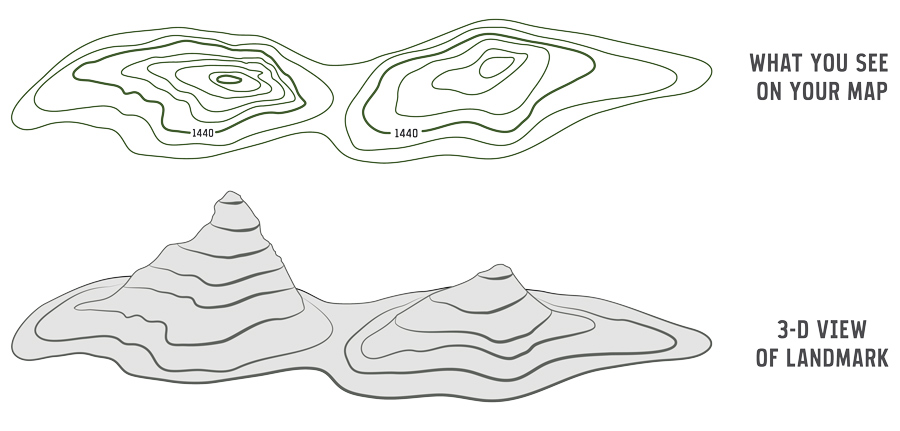
Cartographers have the answer for us
On a map, contour lines link areas of equal height
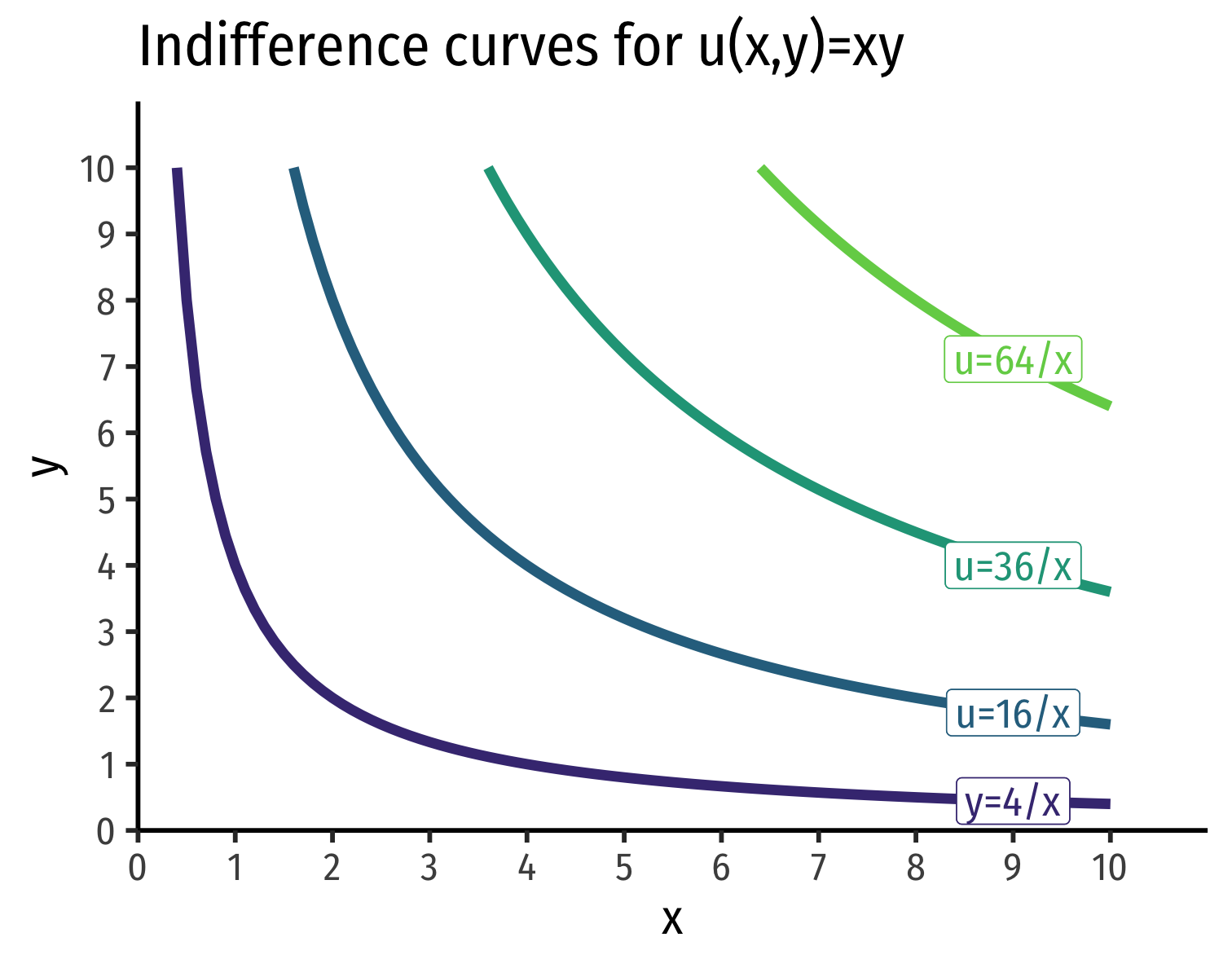
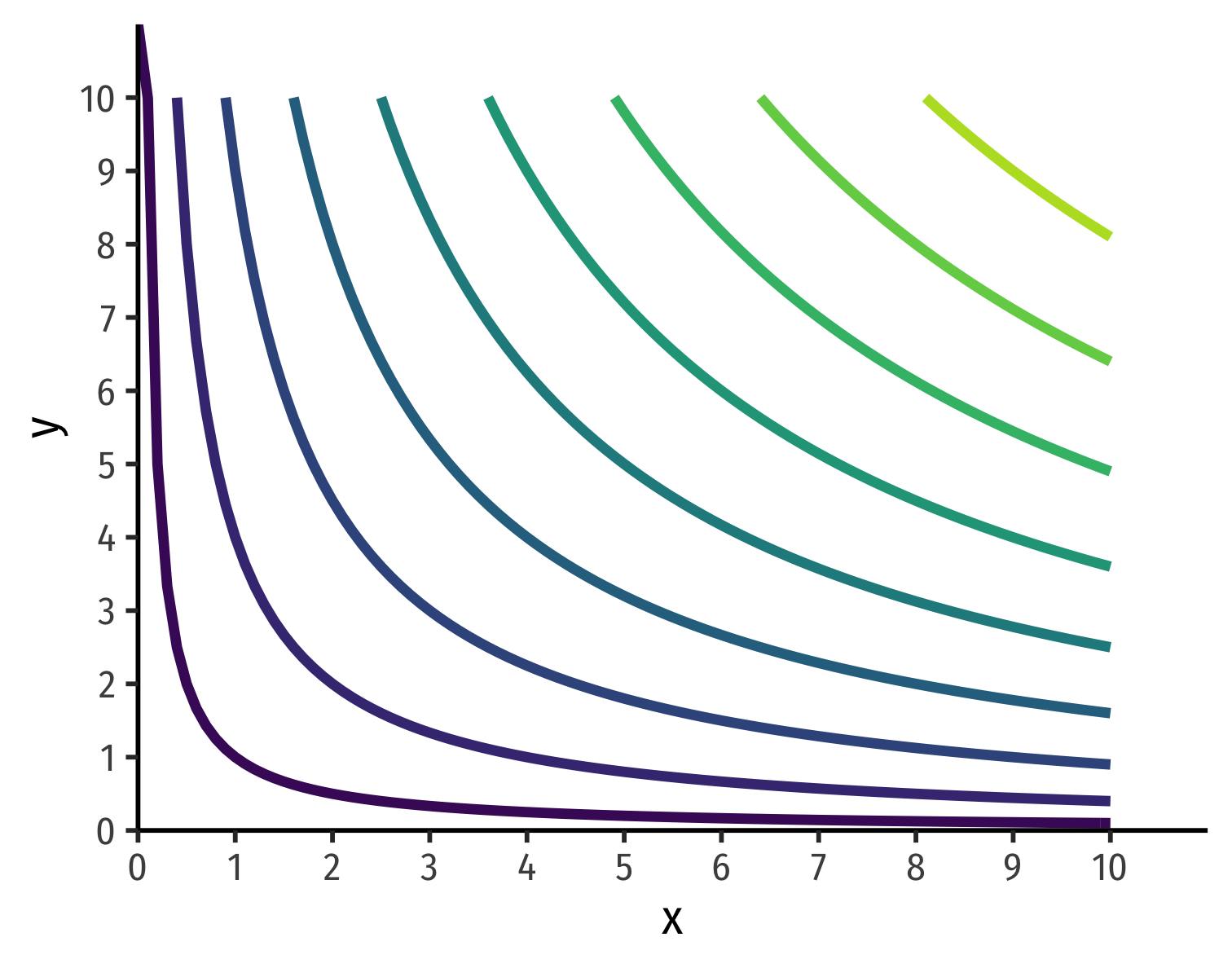
We will use “indifference curves” to link bundles of equal preference
Mapping Preferences Graphically III
3-D “Mount Utility”
2-D Indifference Curve Contours
Indifference Curves: Example
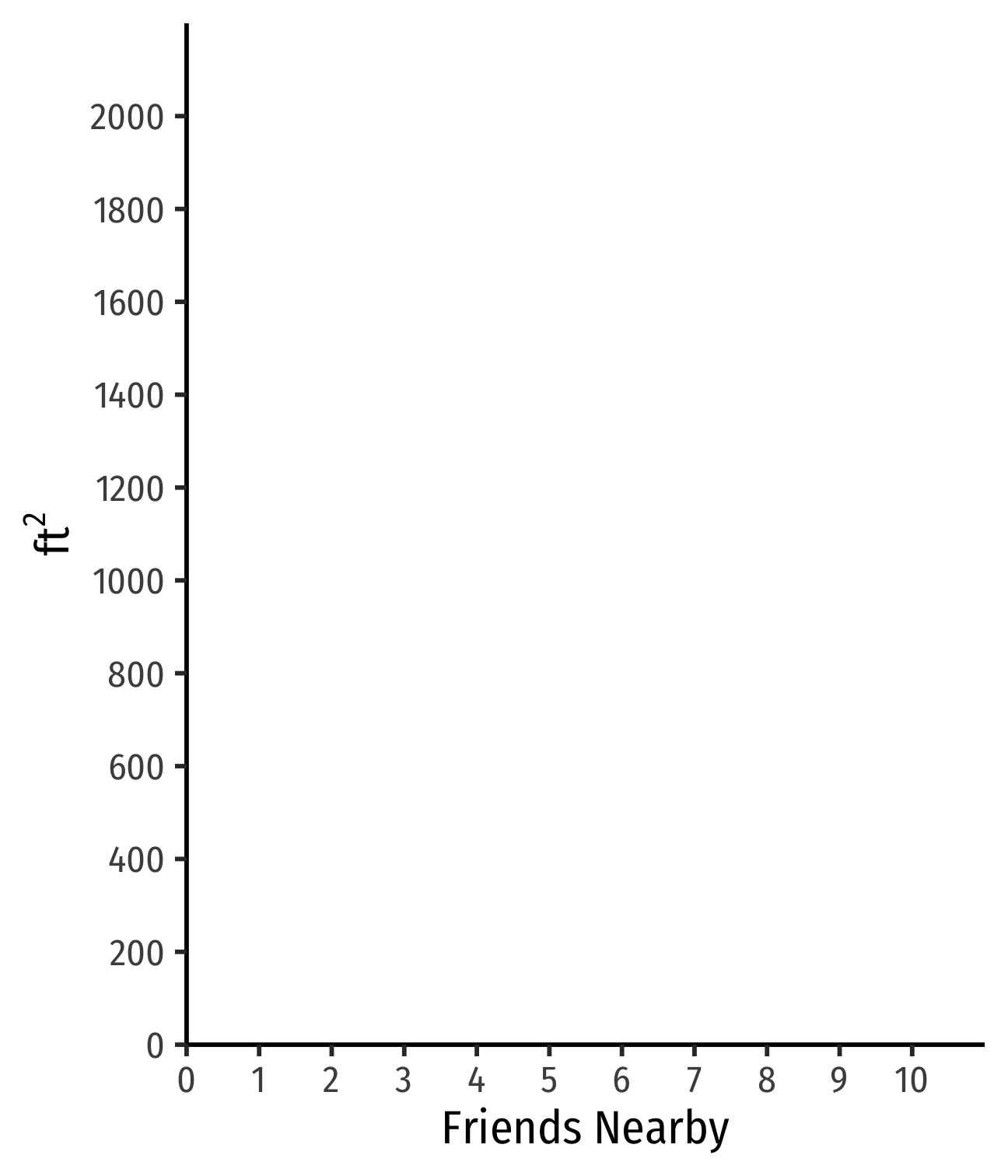
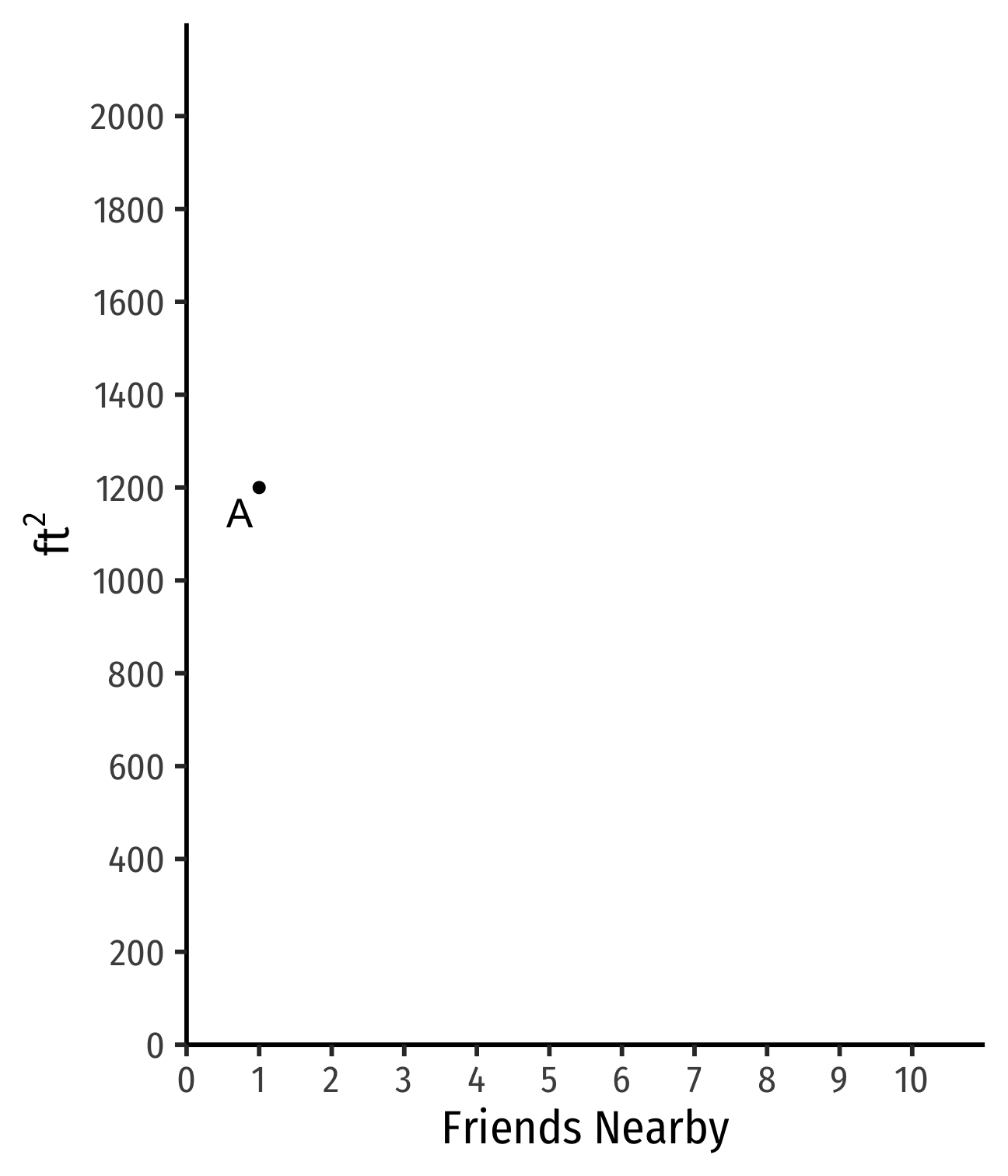
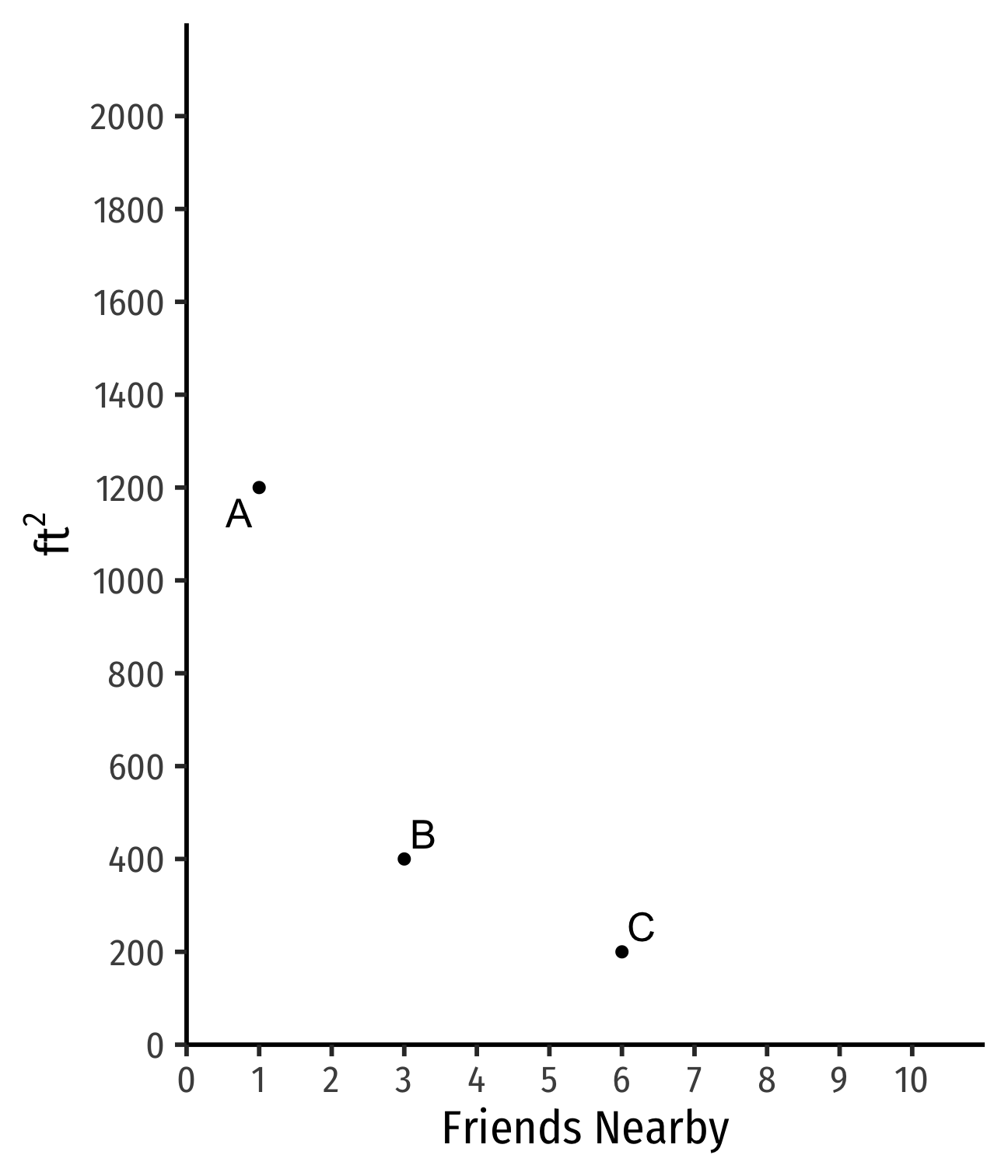
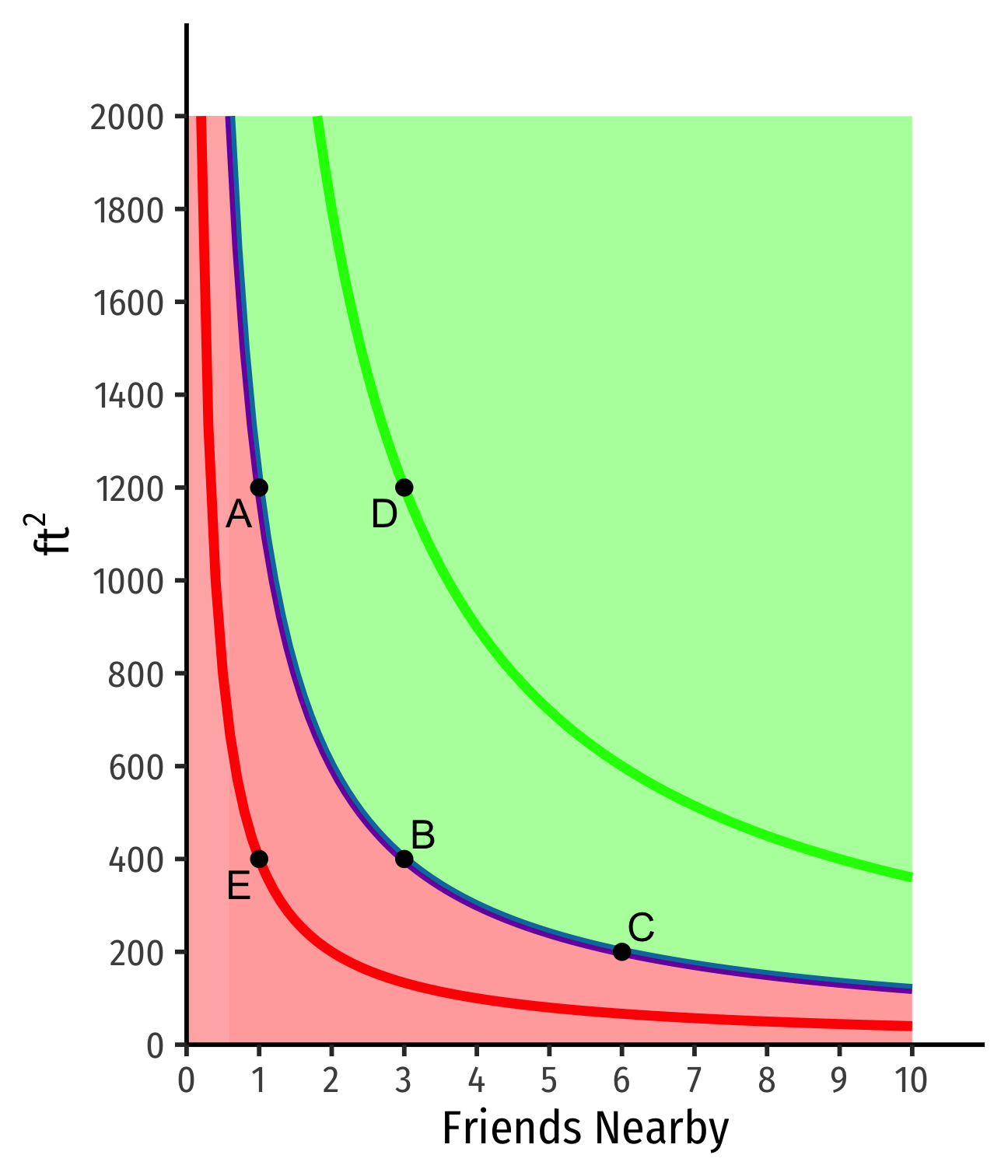
Example: Suppose you are hunting for an apartment. You value both the size of the apartment and the number of friends that live nearby.
Indifference Curves: Example
Example: Suppose you are hunting for an apartment. You value both the size of the apartment and the number of friends that live nearby.
- Apt. A has 1 friend nearby and is 1,200
Indifference Curves: Example
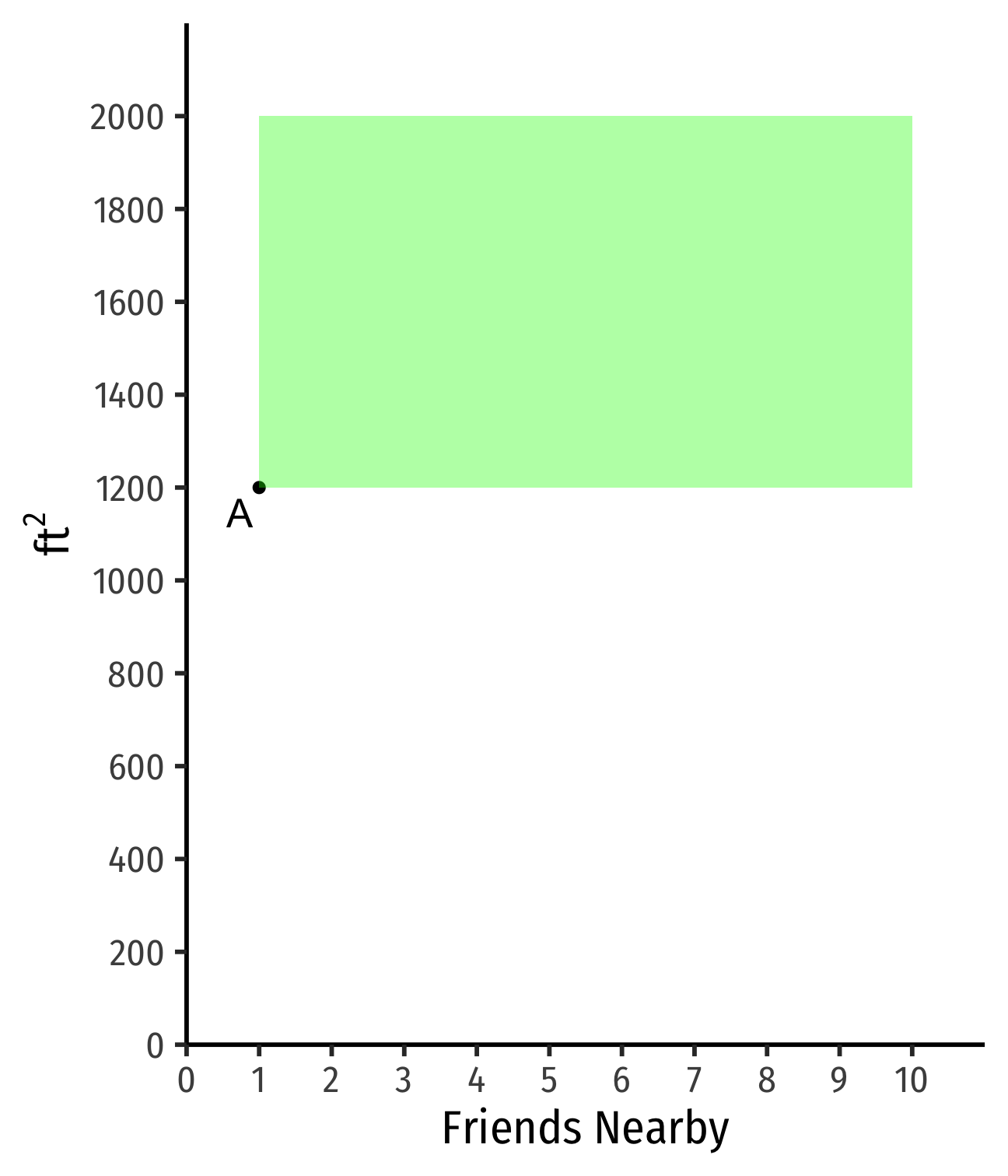
Example: Suppose you are hunting for an apartment. You value both the size of the apartment and the number of friends that live nearby.
- Apt. A has 1 friend nearby and is 1,200
- Apts that are larger and/or have more friends
Indifference Curves: Example
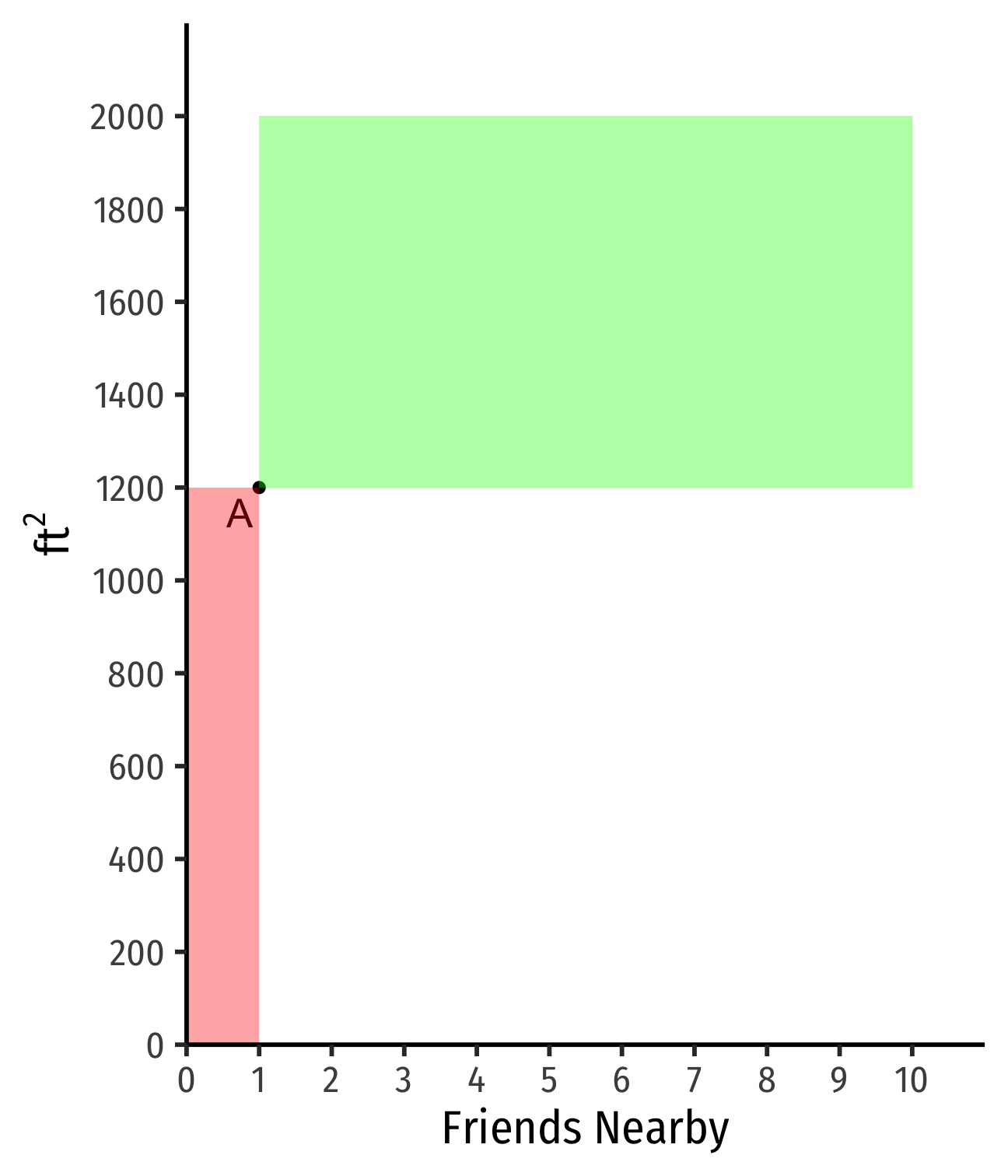
Example: Suppose you are hunting for an apartment. You value both the size of the apartment and the number of friends that live nearby.
- Apt. A has 1 friend nearby and is 1,200
- Apts that are larger and/or have more friends
- Apts that are smaller and/or have fewer friends
Indifference Curves: Example
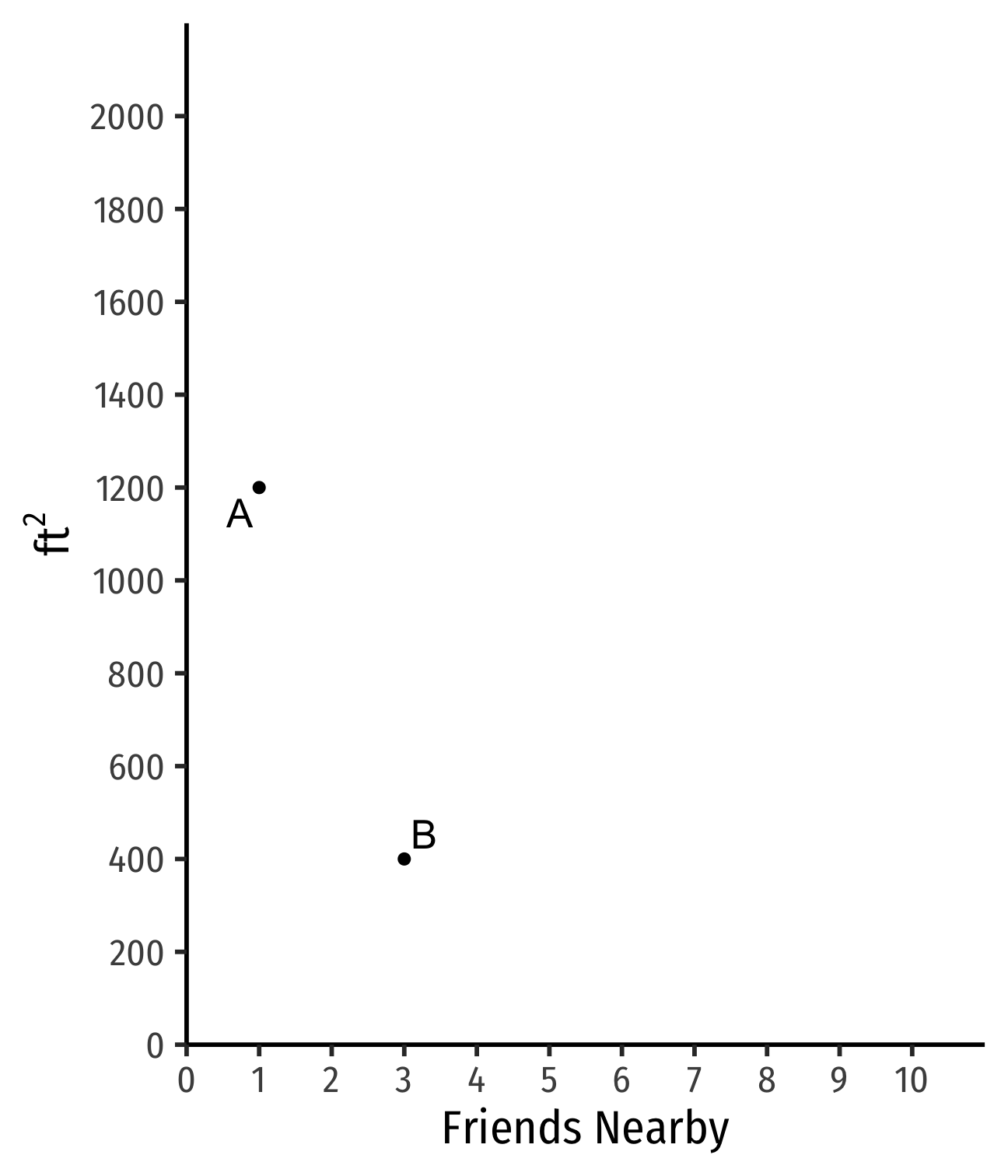
Example:
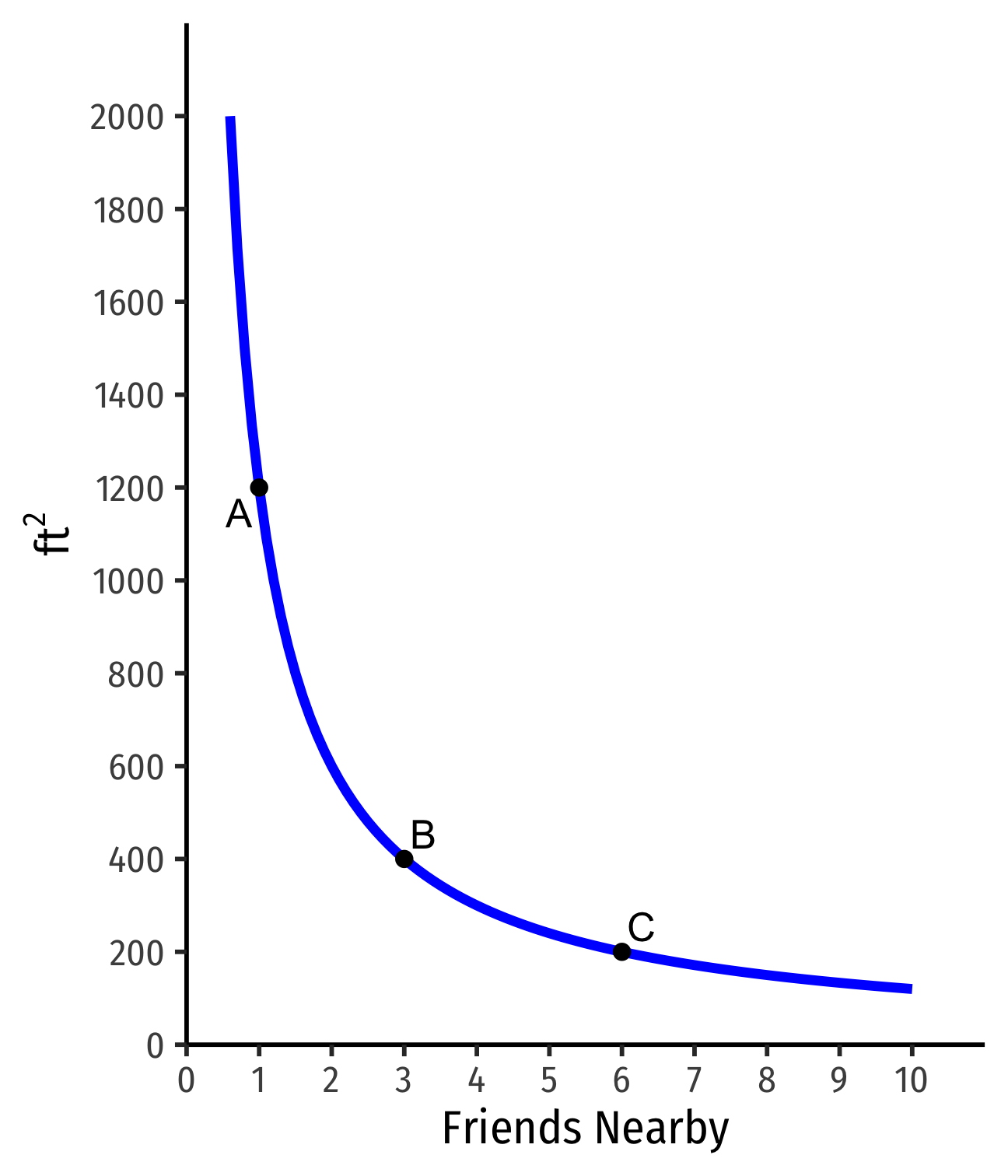
Apt. A has 1 friend nearby and is 1,200
B has more friends but less
Indifference Curves: Example
Example:
Apt. A has 1 friend nearby and is 1,200
B has more friends but less
C has still more friends but less
Indifference Curves: Example
Example:
Apt. A has 1 friend nearby and is 1,200
B has more friends but less
C has still more friends but less
: on same indifference curve
Indifference Curves: Example
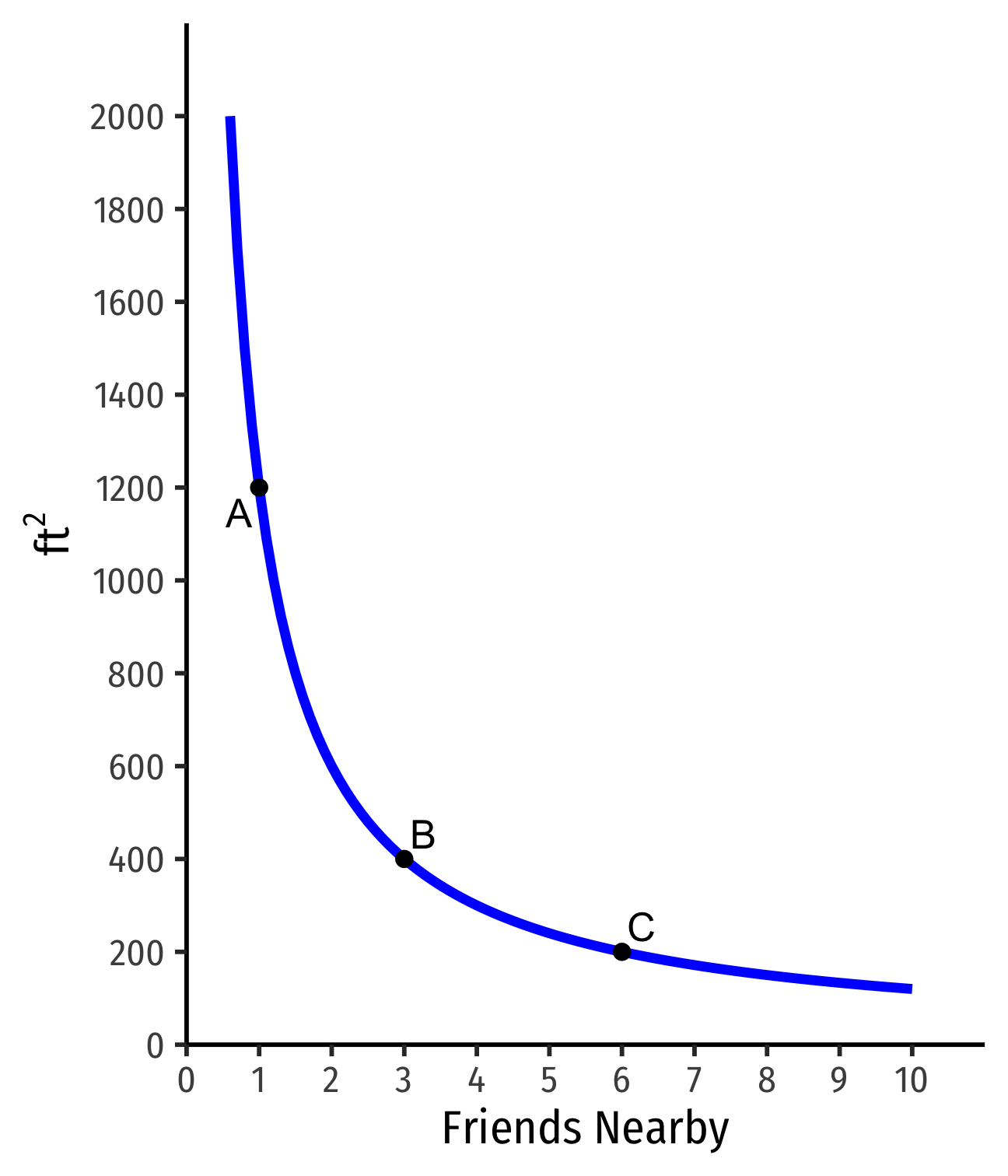
- Indifferent between all apartments on the same curve
Indifference Curves: Example
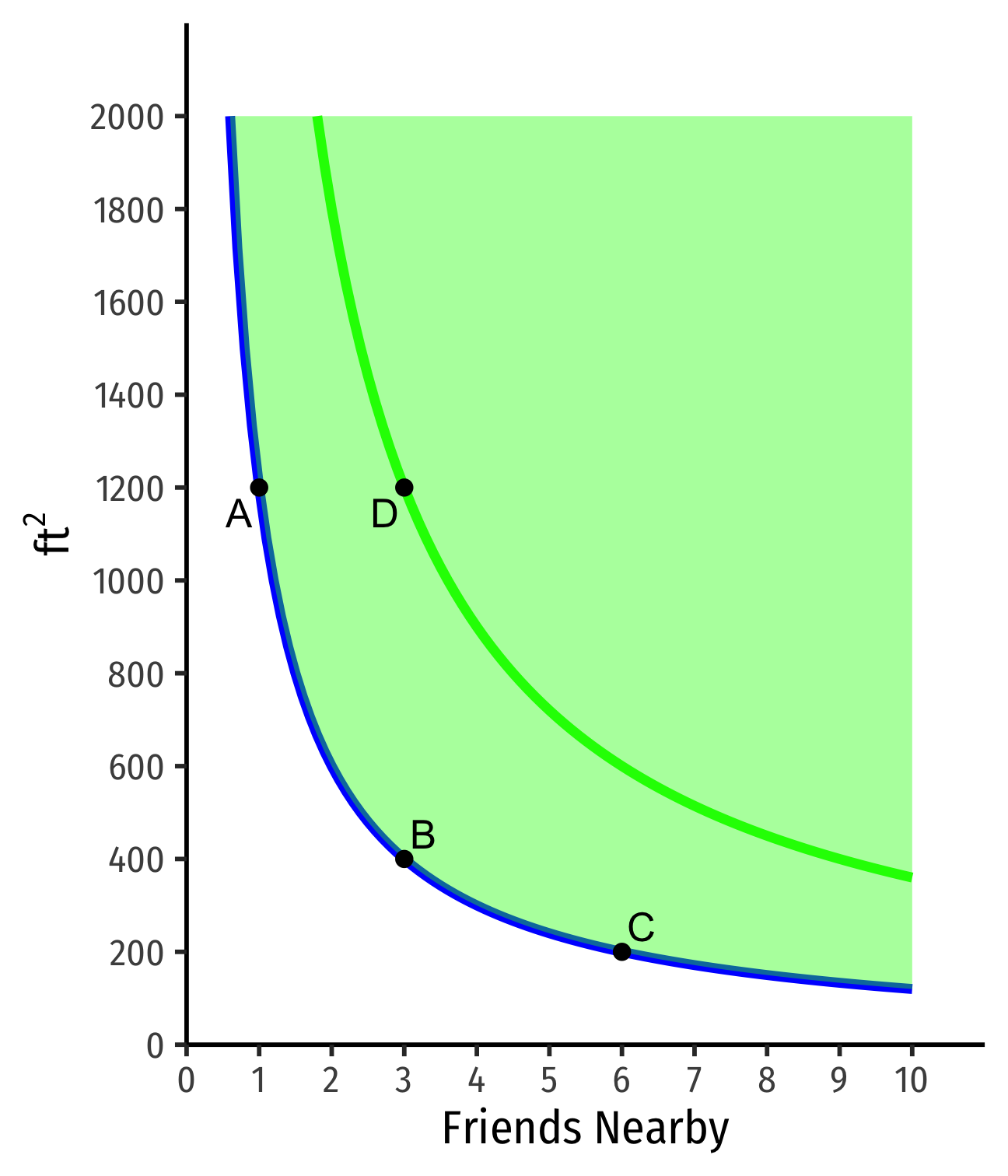
Indifferent between all apartments on the same curve
Apts above curve are preferred over apts on curve
- On a higher curve
Indifference Curves: Example
Indifferent between all apartments on the same curve
Apts above curve are preferred over apts on curve
- On a higher curve
- Apts below curve are less preferred than apts on curve
- On a lower curve
Curves Never Cross!
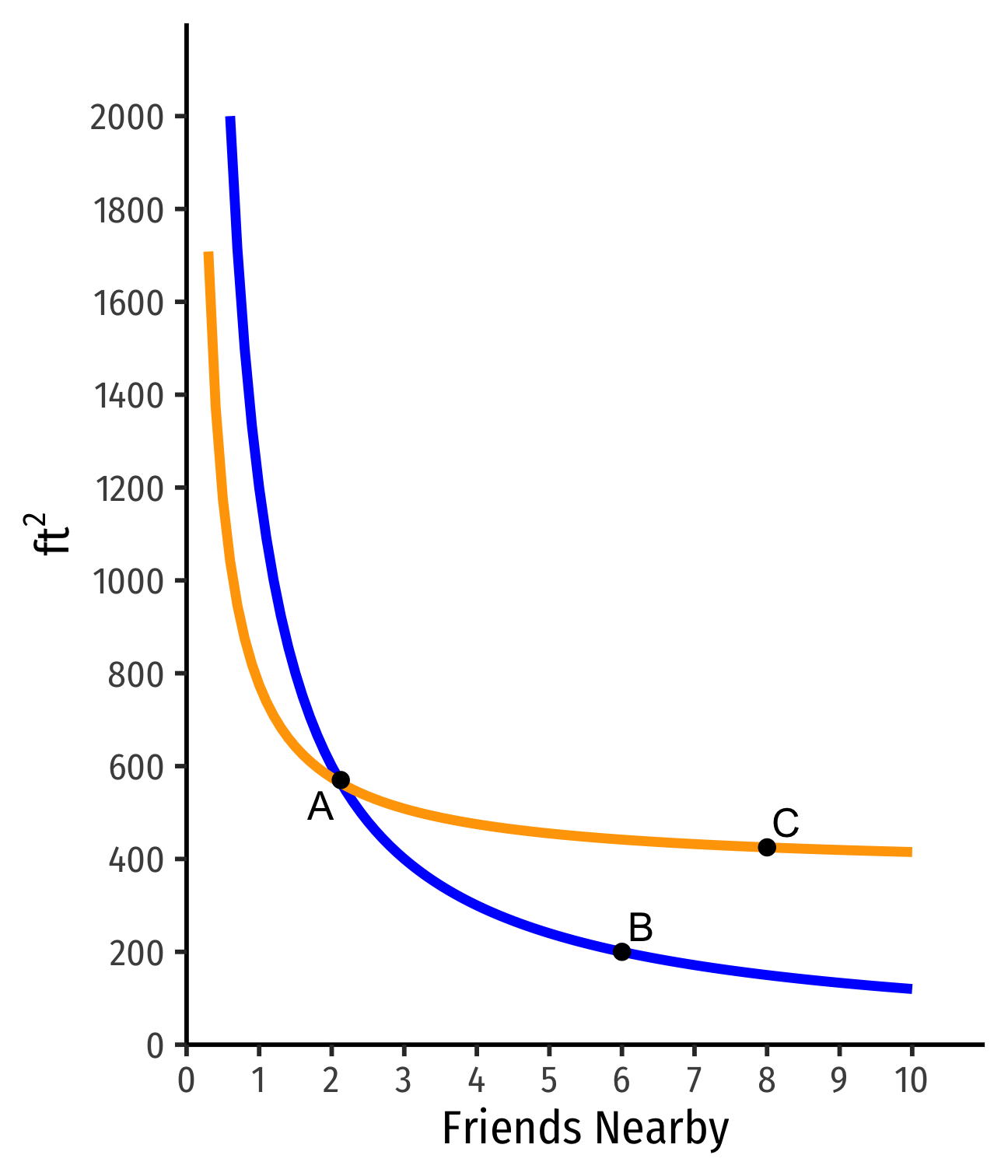
- Indifference curves can never cross: preferences are transitive
- If I prefer , and , I must prefer
Curves Never Cross!
Indifference curves can never cross: preferences are transitive
- If I prefer , and , I must prefer
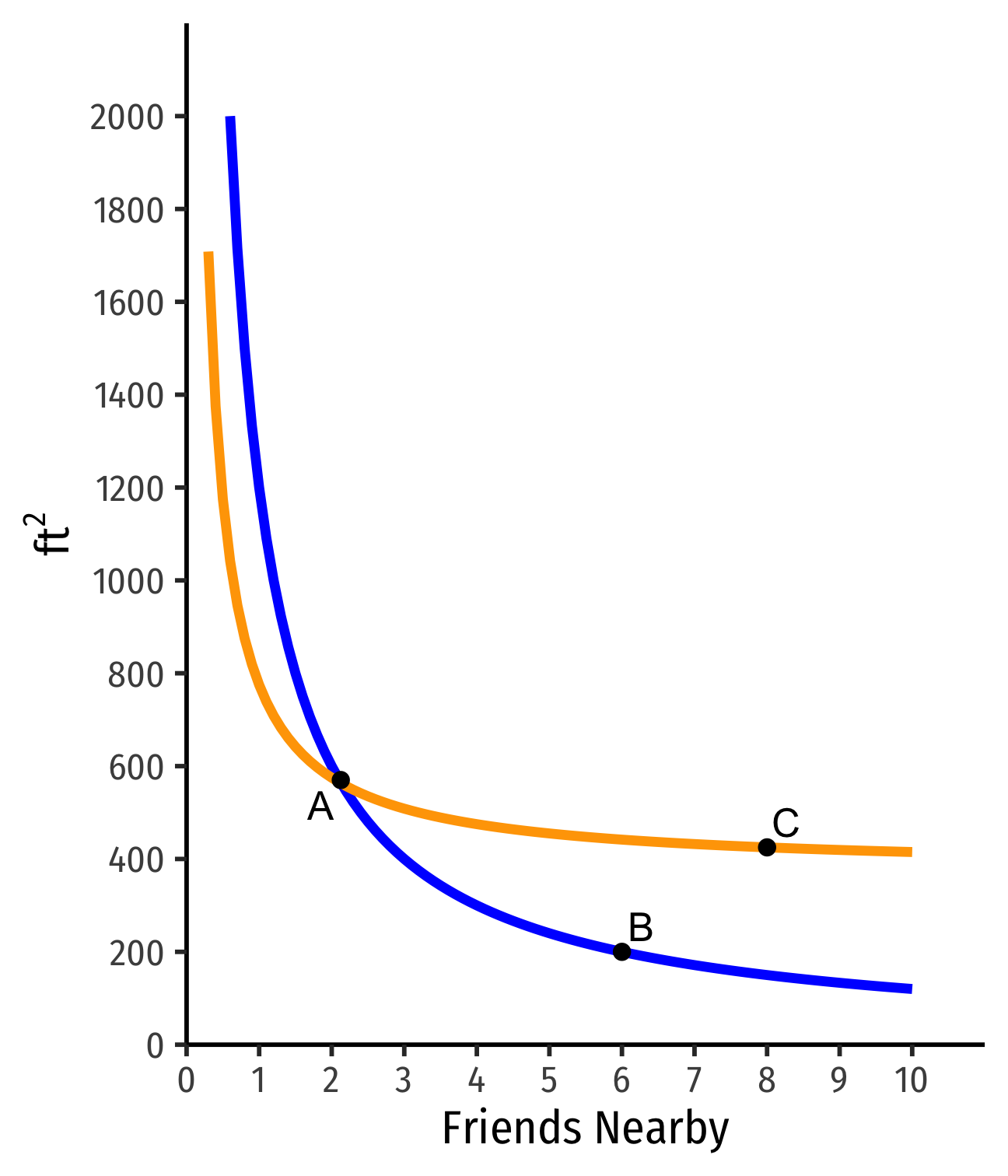
Suppose two curves crossed:
- But !
- Doesn't make sense (not transitive)!
Marginal Rate of Substitution I
- If I find another apt with 1 fewer friend nearby, how many more would you need to keep you satisfied?

Marginal Rate of Substitution I
If I find another apt with 1 fewer friend nearby, how many more would you need to keep you satisfied?
Marginal Rate of Substitution (MRS): rate at which you trade away one good for more of the other and remain indifferent
Think of this as the relative value you place on good :
“I am willing to give up units of to consume 1 more unit of and stay satisfied.”
Marginal Rate of Substitution II
Marginal Rate of Substitution II
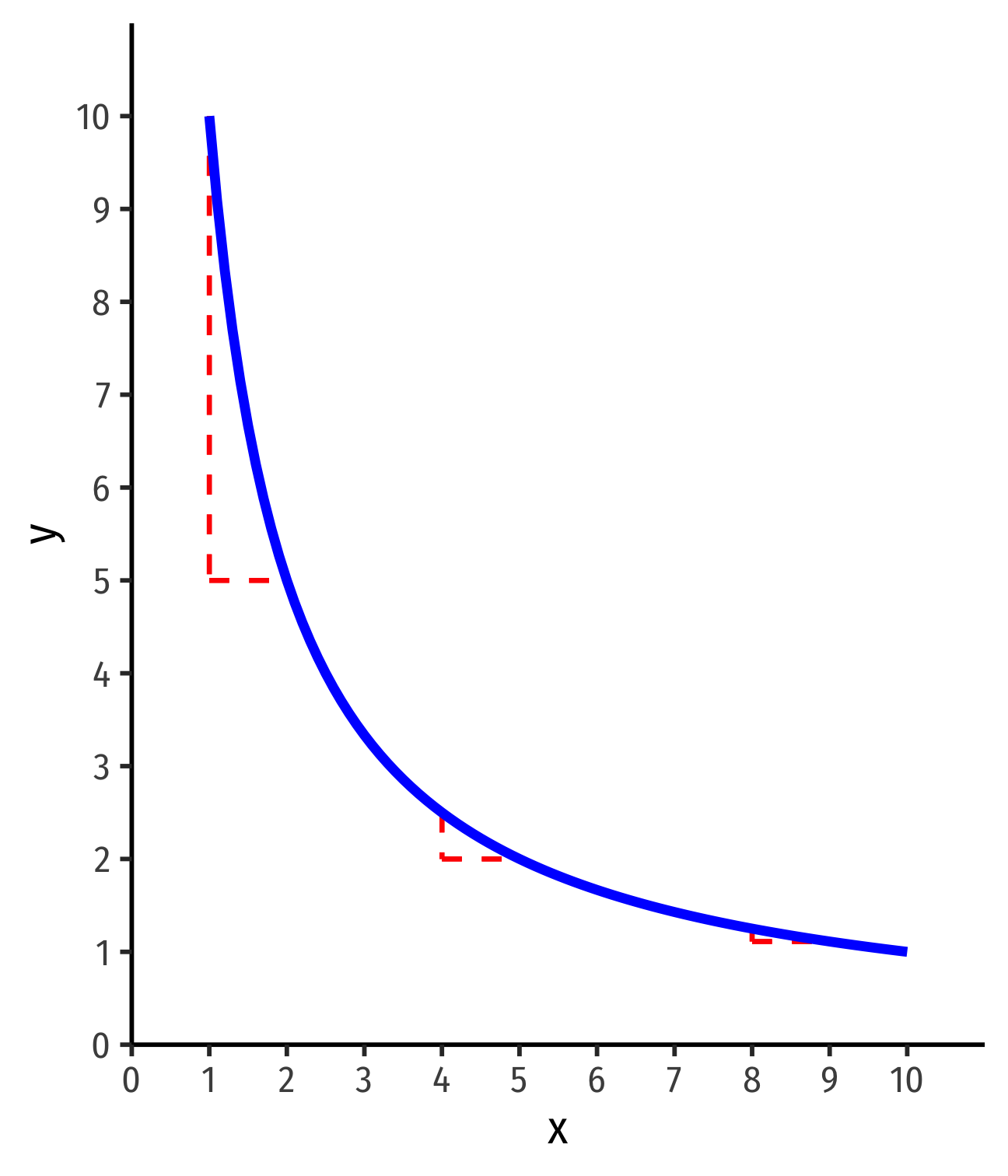
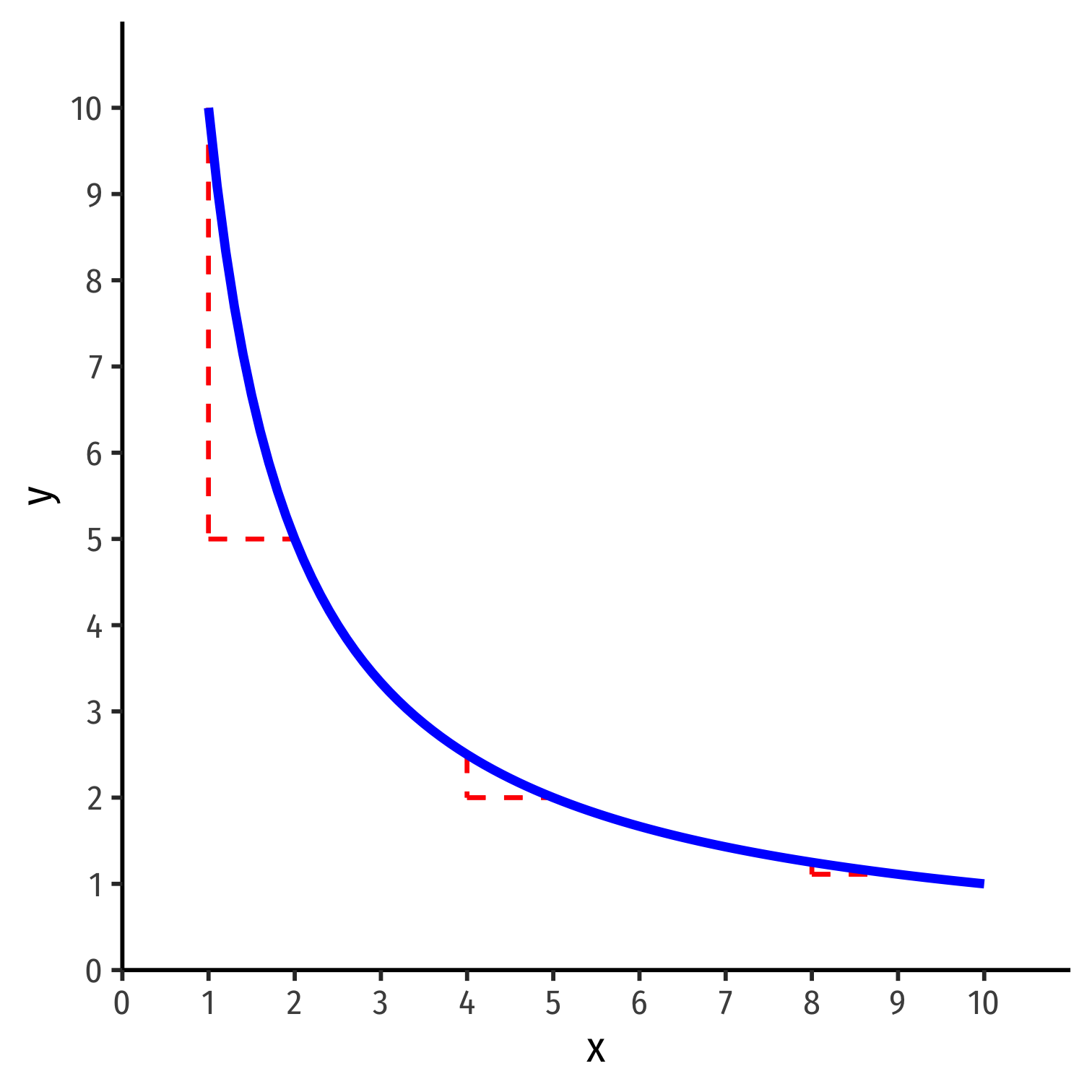
- MRS slope of the indifference curve
Amount of given up for 1 more
Note: slope (MRS) changes along the curve!
MRS vs. Budget Constraint Slope
Budget constraint (slope) from before measured the market’s tradeoff between and based on market prices
MRS here measures your personal evaluation of vs. based on your preferences
Foreshadowing: what if these two rates are different? Are you truly optimizing?
So Where are the Numbers?
Long ago (1890s), utility considered a real, measurable, cardinal scale†
Utility thought to be lurking in people's brains
- Could be understood from first principles: calories, water, warmth, etc
Obvious problems
† “Neuroeconomics” & cognitive scientists are re-attempting a scientific approach to measure utility
Utility Functions?
More plausibly infer people's preferences from their actions!
- “Actions speak louder than words”
Principle of Revealed Preference: if a person chooses over , and both are affordable, then they must prefer
Flawless? Of course not. But extremely useful approximation!
- People tend not to leave money on the table
Utility Functions!
A utility function † represents preference relations
Assign utility numbers to bundles, such that, for any bundles and :
† The is a placeholder for whatever goods we are considering (e.g. , , burritos, lattes, etc)
Utility Functions, Pural III
Utility numbers have an ordinal meaning only, not cardinal
Both are valid utility functions:†
- ✅
- ✅
- because
Only the ranking of utility numbers matters!
† See the Mathematical Appendix in Today's Class Page for why.
Utility Functions and Indifference Curves I
Two tools to represent preferences: indifference curves and utility functions
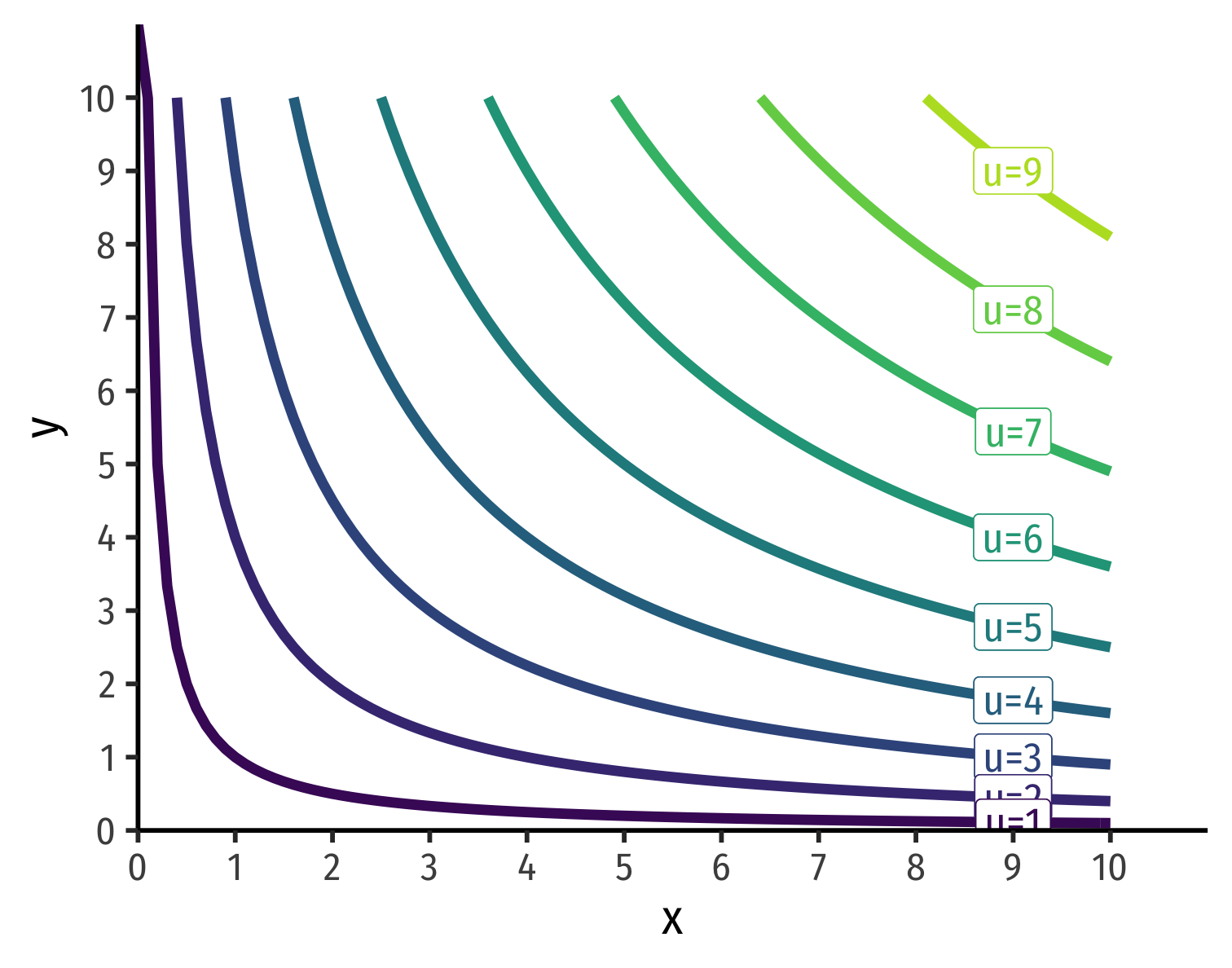
Indifference curve: all equally preferred bundles same utility level
Each indifference curve represents one level (or contour) of utility surface (function)
Utility Functions and Indifference Curves II
3-D Utility Function:
2-D Indifference Curve Contours:
MRS and Marginal Utility I
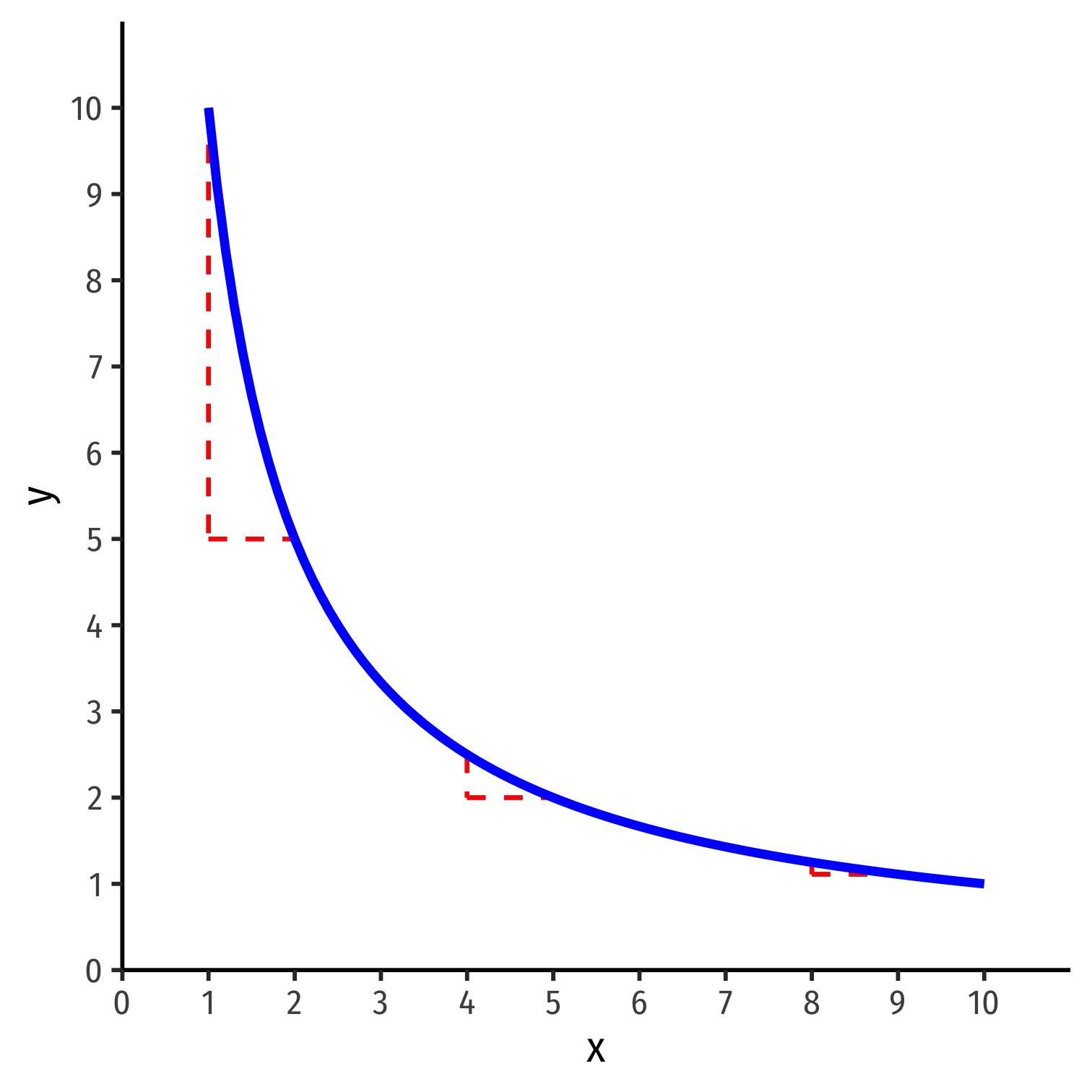
Recall: marginal rate of substitution is slope of the indifference curve
- Amount of given up for 1 more
How to calculate MRS?
- Recall it changes (not a straight line)!
- We can calculate it using something from the utility function
MRS and Marginal Utility II
- Marginal utility: change in utility from a marginal increase in consumption
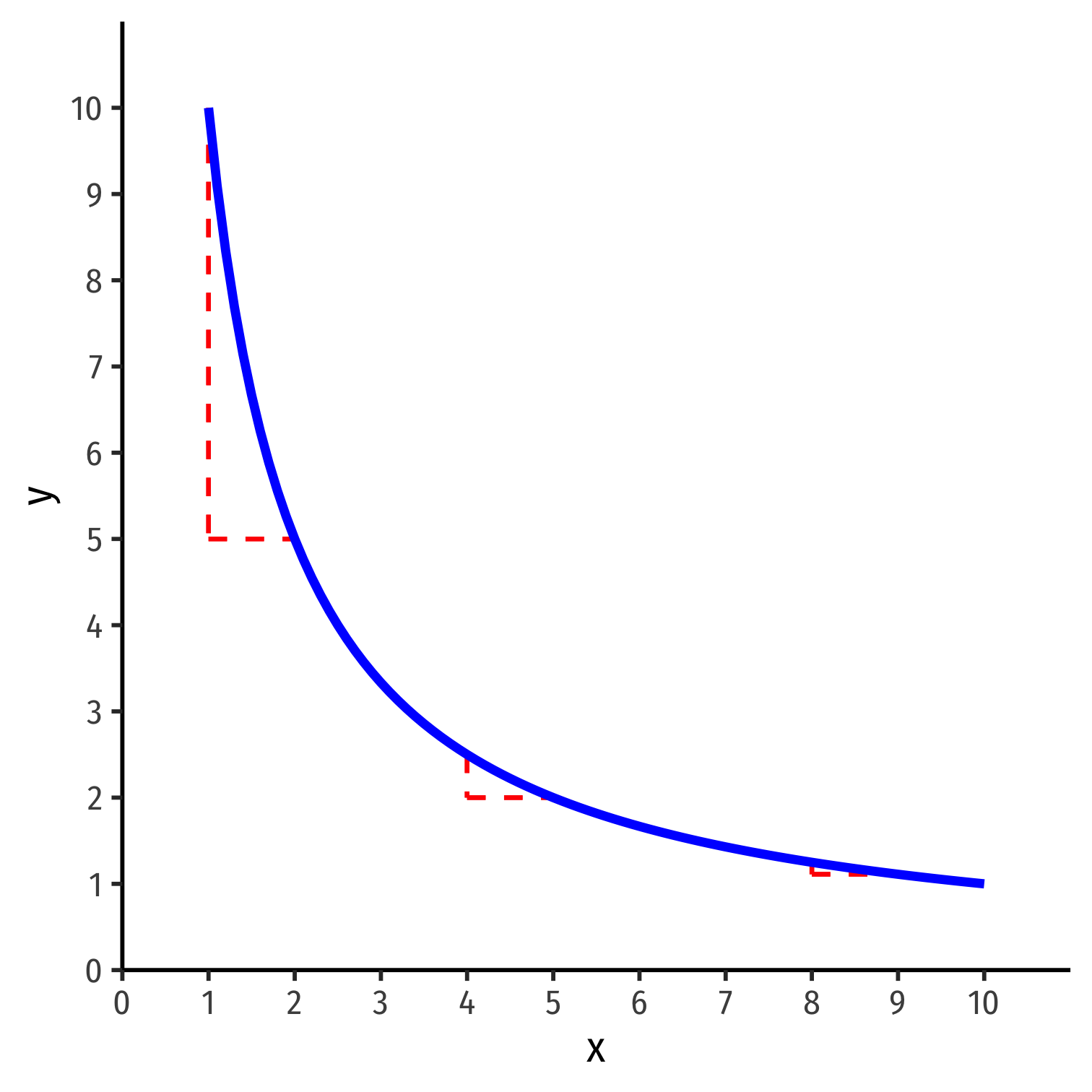
MRS and Marginal Utility II
- Marginal utility: change in utility from a marginal increase in consumption
Marginal utility of :
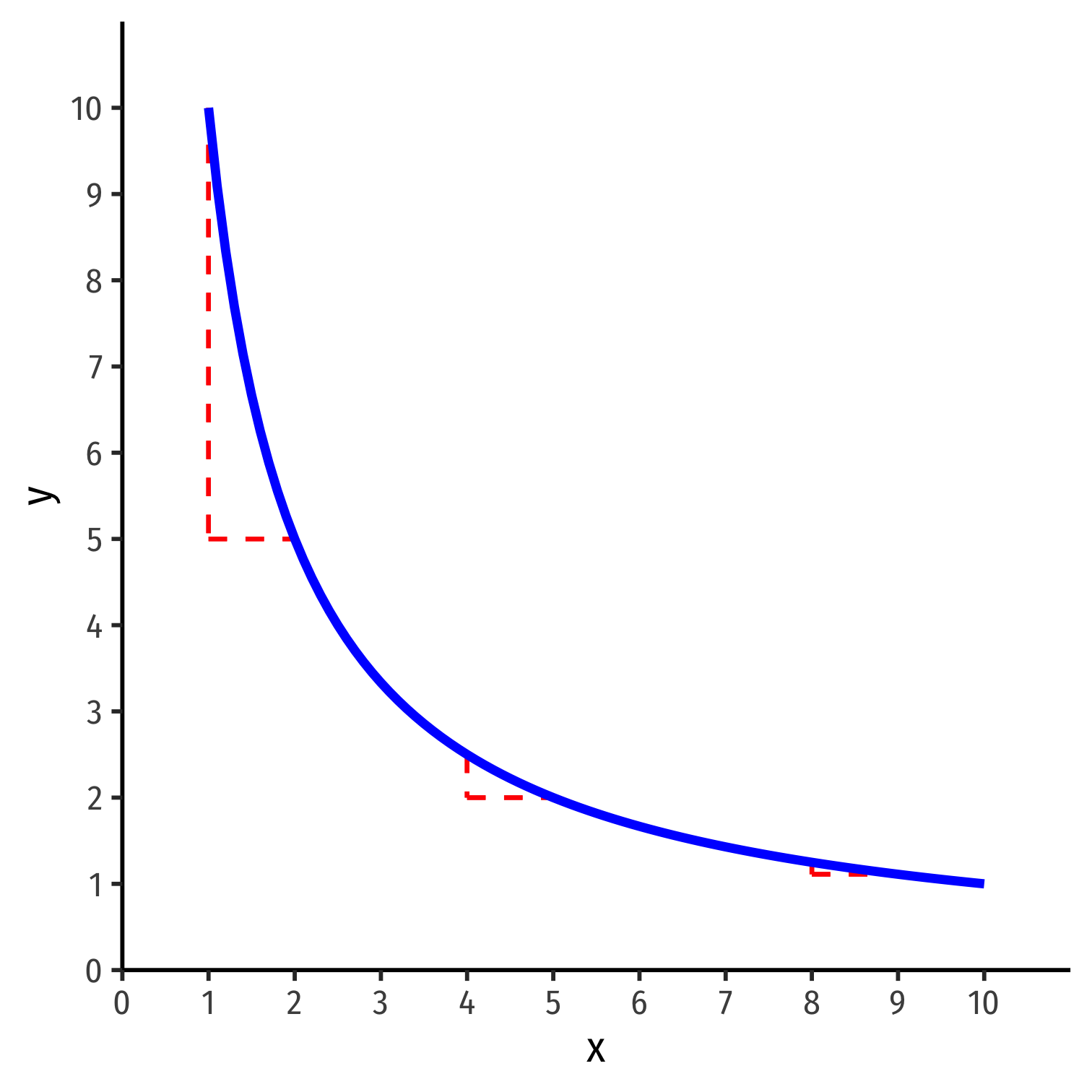
MRS and Marginal Utility II
- Marginal utility: change in utility from a marginal increase in consumption
Marginal utility of :
Marginal utility of :
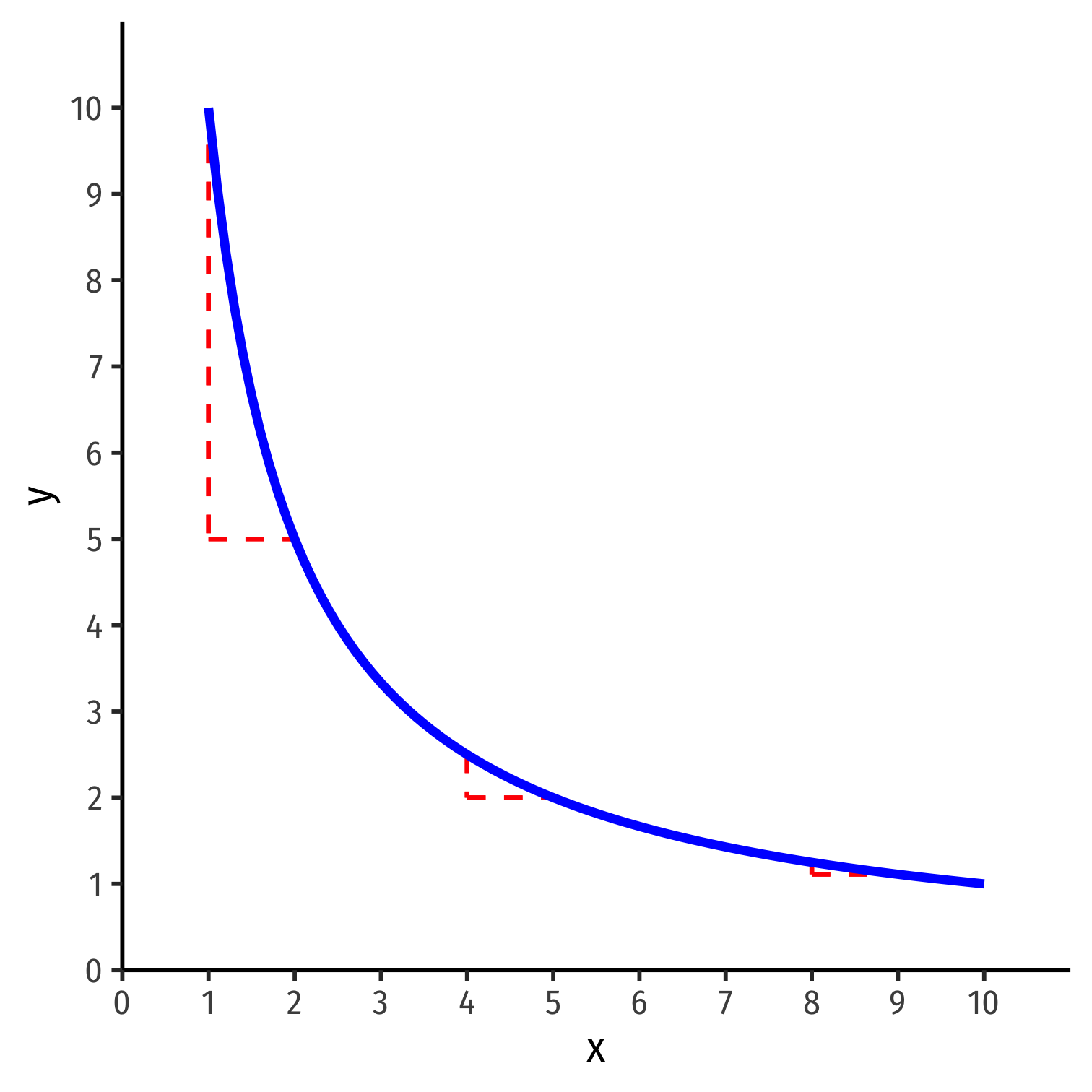
MRS and Marginal Utility II
- Marginal utility: change in utility from a marginal increase in consumption
- Math (calculus): “marginal” “derivative with respect to”
- I will always derive marginal utility functions for you
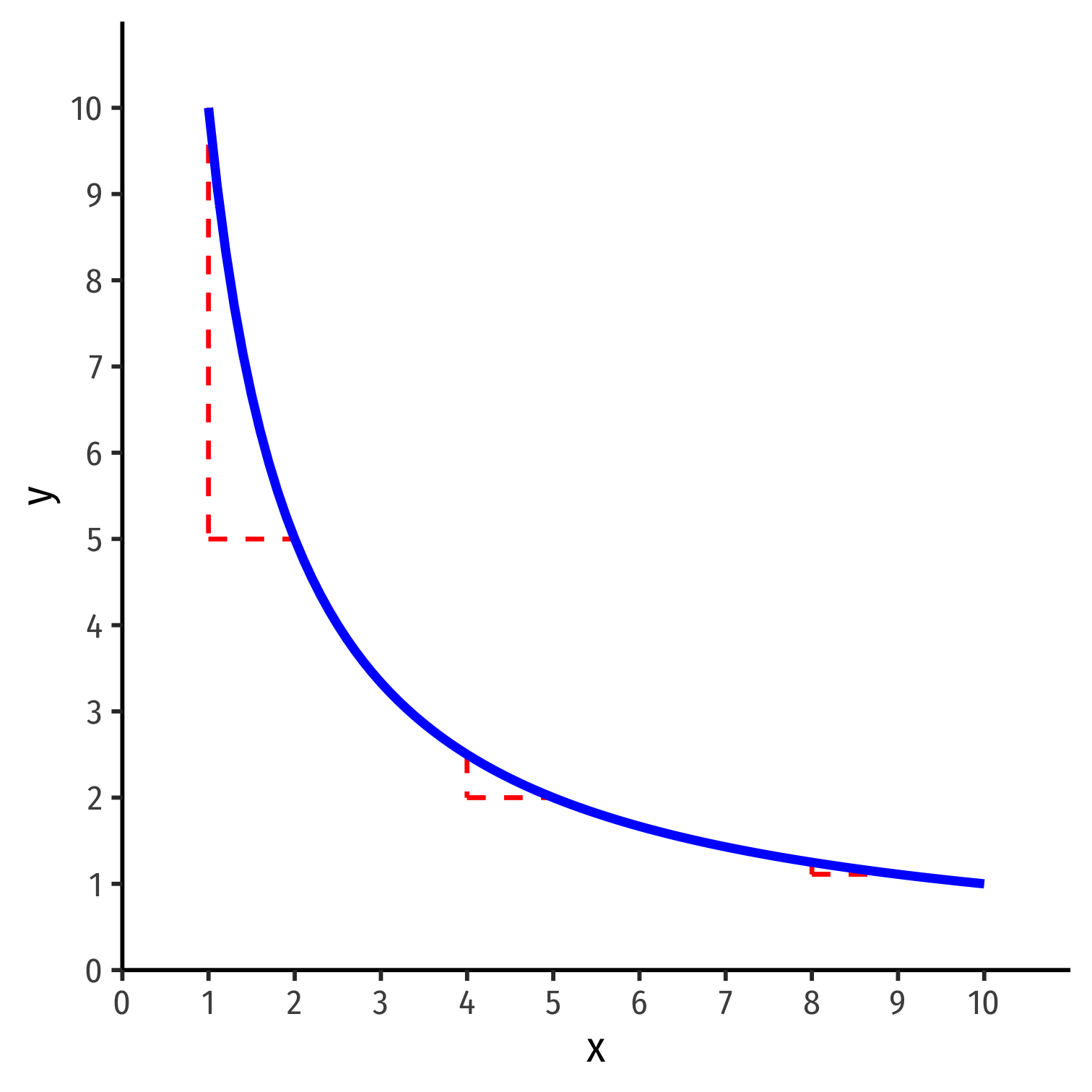
MRS Equation and Marginal Utility
- Relationship between and :
- See proof in today's class notes
“I am willing to give up units of to consume 1 more unit of and stay satisfied.”
Important Insights About Value
“I am willing to give up units of to consume 1 more unit of and stay satisfied.”
- We can't measure 's, but we can measure and infer the ratio of 's!
- Example: if , a unit of good gives 5 times the marginal utility of good at the margin
Important Insights About Value
Value is subjective
- Each of us has our own preferences that determine our ends or objectives
- Choice is forward looking: a comparison of your expectations about opportunities
Preferences are not comparable across individuals
- Only individuals know what they give up at the moment of choice

Important Insights About Value
- Value inherently comes from the fact that we must make tradeoffs
- Making one choice means having to give up pursuing others!
- The choice we pursue at the moment must be worth the sacrifice of others! (i.e. highest marginal utility)
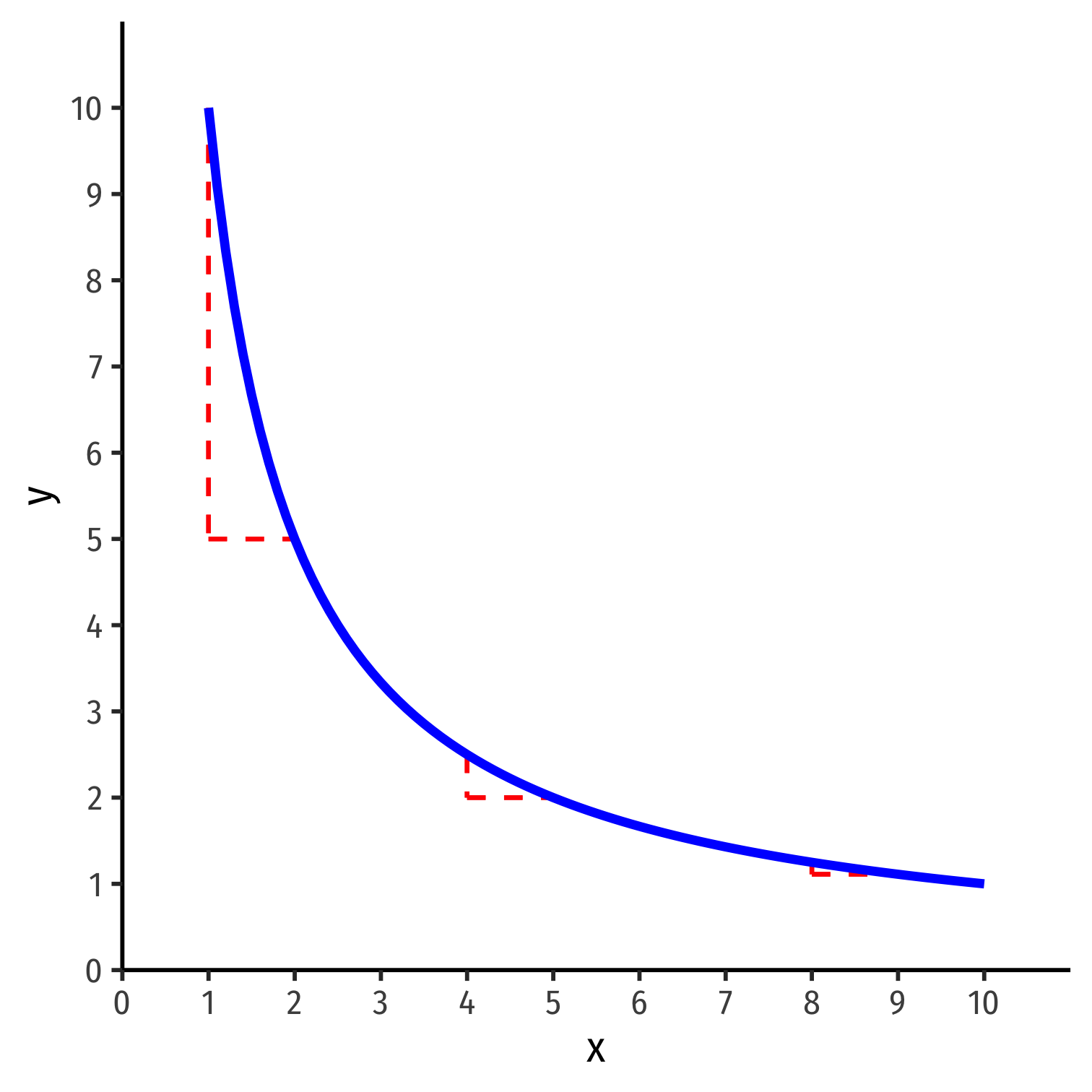
Diminishing Marginal Utility
The Law of Diminishing Marginal Utility: each marginal unit of a good consumed tends to provide less marginal utility than the previous unit, all else equal
- As you consume more :
- : willing to give up fewer units of for

Special Case: Substitutes
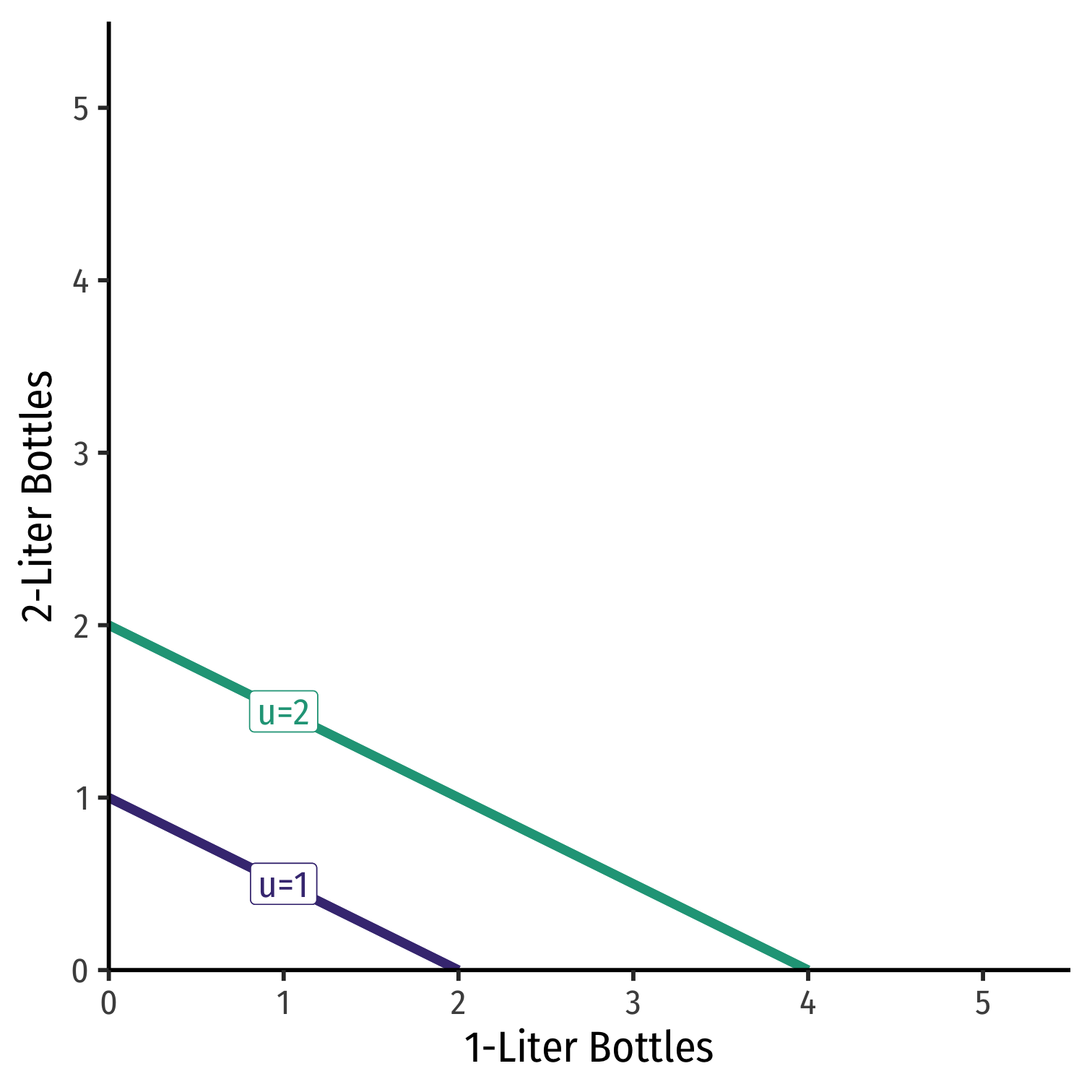
Example: Consider 1-Liter bottles of coke and 2-Liter bottles of coke
Always willing to substitute between Two 1-L bottles for One 2-L bottle
Perfect substitutes: goods that can be substituted at same fixed rate and yield same utility
(a constant!)
Special Case: Complements
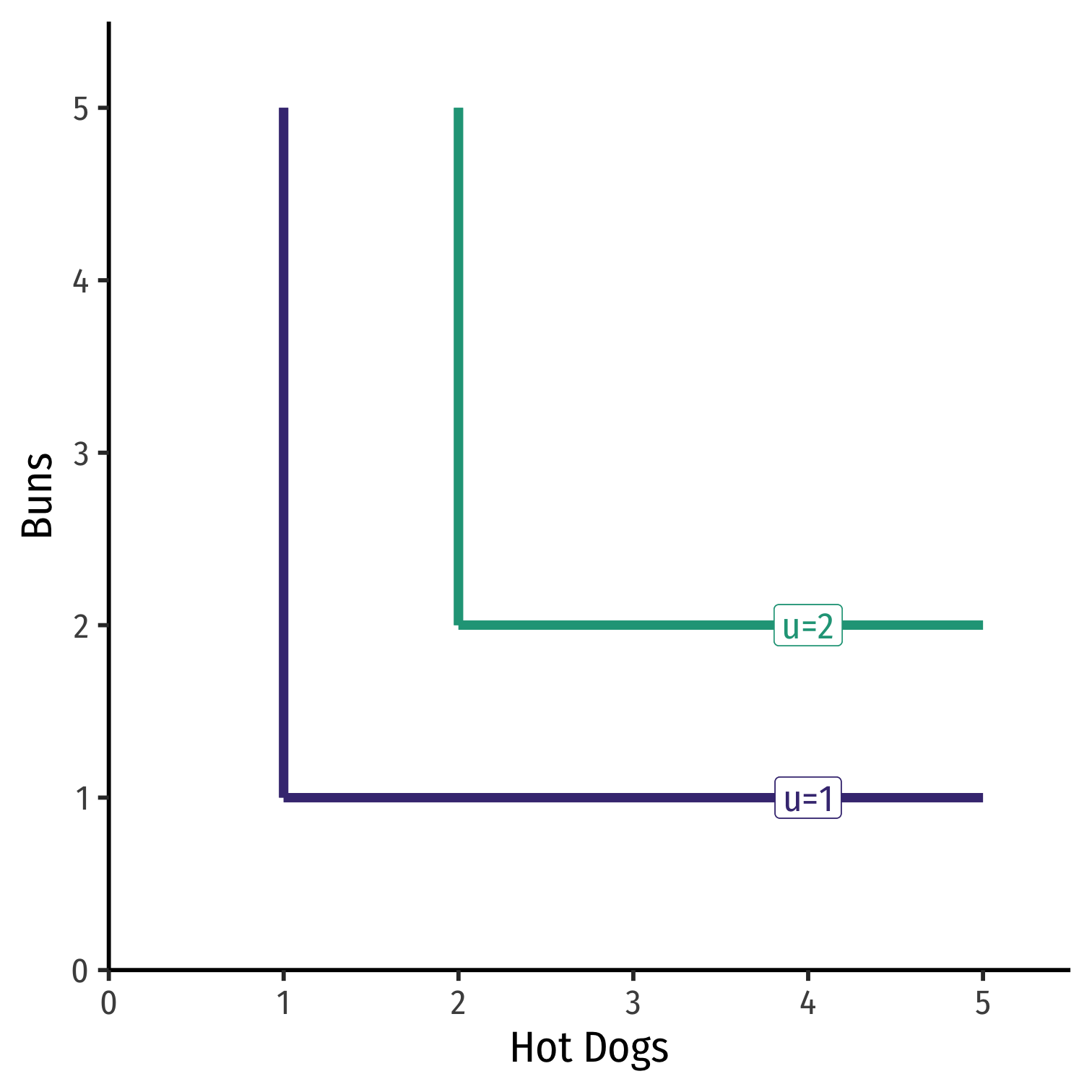
Example: Consider hot dogs and hot dog buns
Always consume together in fixed proportions (in this case, 1 for 1)
Perfect complements: goods that can be consumed together in same fixed proportion and yield same utility
?
Cobb-Douglas Utility Functions
- A very common functional form in economics is Cobb-Douglas
- Extremely useful, you will see it often!
- Lots of nice, useful properties (we'll see later)
- See the appendix in today's class page